SABER Compliance Guide for Electronics · Saudi Arabia

One missed prerequisite, and your container waits — paying demurrage while the approval you skipped runs its full course.

Get the free sample of the Saber Desk Compliance Guide — the SABER/SASO certification path for importing electronics into Saudi Arabia, in the exact order the system enforces. Bilingual PDF, full English and full Arabic.

  • 17 pages per language · English and Arabic editions
  • August 2026 edition
  • Official sources only: saber.sa · saso.gov.sa · cst.gov.sa · sls.gov.sa
  • 7-day no-questions refund

What the Compliance Guide covers

One current, verified reference instead of scattered portals and out-of-date forum posts. Bilingual — full English and full Arabic — so your team and your supplier work from the same document.

  • The enforced order

    The entire PCoC/SCoC process in the order SABER actually demands — with a printable one-page checklist of the whole path.

  • The prerequisite stack

    CST type approval, IECEE recognition (JEEM), SASO RoHS (IEC 63000), and energy-efficiency registration (SLS) — what applies, and when.

  • Real costs and timelines

    The three cost layers, platform fees, realistic timelines for each step, and a budget worksheet for one product's first year.

  • The 7 customs traps

    The failures that strand the most shipments — each with its fix, plus the line-by-line invoice-matching checklist.

Inside the full guide — 10 sections + appendices · 17 pages per language · English and Arabic editions:

  1. 1Fast-Start: how Saudi import compliance actually works — plus the Executive Workflow map
  2. 2Is your product regulated? HS codes and the two paths
  3. 3The prerequisite stack: CST · IECEE (JEEM) · RoHS · energy efficiency
  4. 4Registering on SABER + choosing your Certification Body
  5. 5The PCoC: the file that passes, and the two rules that decide it
  6. 6The SCoC: the per-shipment flow, Ministry-of-Industry list, FASAH
  7. 7Special cases: samples, personal use, non-commercial imports
  8. 8Costs & timelines: the real numbers + budget worksheet
  9. 9The 7 customs traps — and the fix for each
  10. 10Appendices: checklists, Certification Bodies, every official link
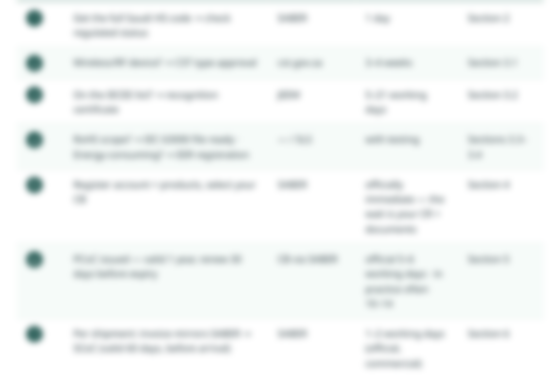
  • Blurred preview: the Executive Workflow table from the sample
    The Executive Workflow — one table, the whole path
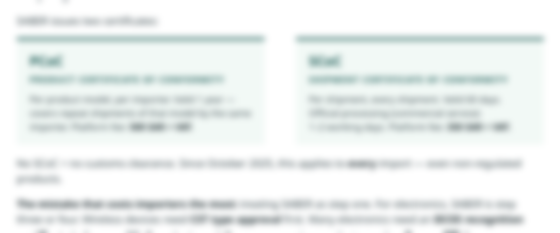
  • Blurred preview: the PCoC and SCoC certificate cards from the sample
    The two certificates, side by side
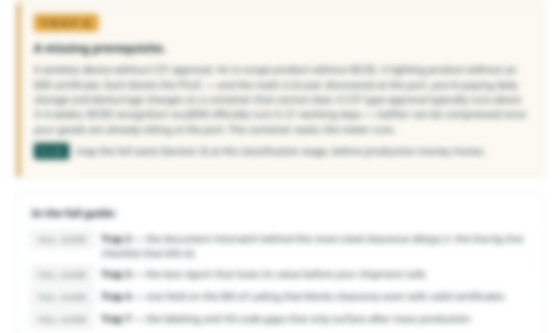
  • Blurred preview: customs-trap cards from the sample
    The customs traps — each with its fix

Start with the free bilingual sample

For importers, trading companies, freight forwarders, customs brokers, and overseas manufacturers selling electronics into Saudi Arabia.

  • Step 1 — Is your product even regulated? How to check, starting from your HS code and the SABER lookup.
  • Step 2 — The prerequisite stack. What comes before the certificate — and which items apply to you.
  • Step 3 — PCoC basics. What the Product Certificate of Conformity covers and what triggers it.
  • A preview of the One-Page Process Checklist.
  • 3 of the 7 Customs Traps that strand the most shipments.

The full Compliance Guide

Every prerequisite mapped at the classification stage, step-by-step PCoC and SCoC sections, special cases, all 7 customs traps with the fix for each — current as of August 2026, verified against official sources only.

49 USD, one-time. Instant PDF download after payment.

7-day no-questions refund.

Format
Two PDFs — full English edition + full Arabic edition
Length
17 pages each · 10 sections + appendices
Edition
August 2026 (printed on the cover)
Delivery
Instant download after payment; the link is also in your receipt email
Refund
7 days, no questions asked — reply to your receipt email

Questions before buying? hello@saberdesk.com

Get the full Compliance Guide

How this guide is maintained

A reference without a byline has to earn trust with its method, not with testimonials. This is the method.

Official sources first

Fees, validity periods and processing times come from the official service pages and FAQ on saber.sa, and from saso.gov.sa, cst.gov.sa, sls.gov.sa, jeem1.saso.gov.sa, fasah.sa and mim.gov.sa. Inside the guide, official figures and observed-practice figures are always kept apart.

Practice figures, labelled

Where no official number exists — how long Certification Bodies actually take, what lab testing really costs — the guide gives a range drawn from several independent sources and says so. Official and observed figures are never blended into one "typical" number.

The rule for every fact

Official figure first, then multiple independent sources, then an honest range — and if none of those exists, the claim is dropped rather than guessed. Nothing is invented to fill a gap.

Edition and freshness

Current edition: August 2026, including the January 2025 pre-arrival rule and the October 2025 shipment-certificate requirement. The edition date is printed on the cover and shown on this page. The guide also flags the areas that move — HS codes and standards change in waves — so you confirm them with your Certification Body before each shipment.

Scope, on purpose

Electronics and electrical goods only. Other categories follow a similar SABER process but different technical regulations — this guide is deliberately not written for them.

No certification upsell

We are not a certification body and sell no certification services, so nothing in the guide steers you toward a paid service, and no fee or timeline is softened. Found something outdated? hello@saberdesk.com — corrections go into the next edition.

Frequently asked questions

What exactly is in the guide?

The full SABER/SASO certification path for importing electronics into Saudi Arabia, in the order the system enforces: how to tell if your product is regulated (from your HS code), the prerequisite stack (CST type approval, IECEE recognition via JEEM, RoHS, energy-efficiency registration), step-by-step PCoC and SCoC sections with fees and timelines, the 7 customs traps, an invoice-matching checklist, a one-page process checklist, and a first-year budget worksheet. 10 sections plus appendices — 17 pages per language, full English and full Arabic.

Who is it for?

Importers, trading companies, freight forwarders, customs brokers, and overseas manufacturers selling electronics or electrical goods into Saudi Arabia. It's specific to electronics — other categories follow a similar SABER process but different technical regulations, so this isn't the right guide for them.

How does delivery work?

Instant download immediately after payment — two PDFs, one full English edition and one full Arabic edition. No account needed; the download link also lands in your receipt email.

What is the refund policy?

7-day no-questions refund. If the guide isn't what you needed, reply to your receipt email within 7 days of purchase and the payment is returned — no forms, no justification required.

Is this an official SABER or SASO document?

No. We are an independent reference, not a certification body, and not affiliated with SASO. We do not issue PCoCs, SCoCs, or any certificate — certificates come only from SASO-approved Certification Bodies through the SABER platform. The guide explains the process and helps you avoid the expensive mistakes; it is not legal or trade counsel.

Is the guide up to date? What if regulations change after I buy?

Current as of August 2026, including the January 2025 pre-arrival certificate rule and the October 2025 shipment-certificate requirement — every fact verified against official sources only (saber.sa, saso.gov.sa, cst.gov.sa, sls.gov.sa). The guide also flags the areas that move (standards and HS codes change in waves): before acting on a specific shipment, confirm your HS code and required standard with your Certification Body — a rule the guide itself repeats.

Is the Arabic version a translation?

It's a full فصحى (Modern Standard Arabic) edition prepared from the same verified source — not a machine translation. Both languages carry the same facts and the same structure.

Can I share the guide with my supplier?

Yes — that's exactly why it's bilingual. Your team in Saudi Arabia and your supplier abroad work from the same document, each in their own language, so nothing gets lost between the two ends of the shipment.